
AMSAT-LU
Satellite Data
|
AMSAT-LU |
|
Catalog number: 40012
Launch Date: June 17, 2014
Status: Operational.
| Downlink/Beacon: | 437.425 MHz | 9600 FSK |
UNISAT-6 transmits in the amateur radio frequencies. Any radio amateur is invited to receive the satellite telemetry and post it below this post or sending us binary files to info@gaussteam.com (Tell us if we can put your name on the credits in the website). We will periodically plot graphs of the status of the satellite based on the data you send us.
The spacecraft has a UHF transceiver dedicated both as TT&C and digipeater for HAM radio amateurs. The digipeater feature will be disabled during the first part of the mission and it will be enabled only when the primary mission of the satellite has been completed. We will be posting details of this on the website and twitter.
Unisat-6 working frequency is 437.425 MHz, it uses a GFSK modulation at 9600bps with a standard AX.25 protocol. The satellite will transmit with a power of 2W with RHCP. The callsign of the satellite is II0US.
In order to receive the satellite you will need a radio capable of receiving at 437.425 MHz and +- 10KHz for adjusting the doppler shift; a software to automatically correct the radio frequency would be desired. You will also need a TNC capable of demodulating FSK at 9600 bps and that supports AX.25 protocol.
Beacon Format
Unisat-6 will transmit 2 beacons:
Beacon 1: 'UNISAT-6' transmitted every 30 seconds with 8 bytes that are transmitted only when the satellite is not being commanded from ground.
Beacon 2: Binary packet transmitted every 10 seconds consisting of 67 bytes with house keeping data of the satellite.
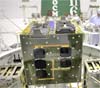
UniSat 6 is a technology satellite built at GAUSS (La Sapienza University of Rome).
It is intended to test customer equipment under space conditions and to deploy four cubesats in orbit.
The UniSat-6 is based on the UniSat 5 satellite platform built from reinforced aluminum and carbon honeycomb panels.
It measures 50 cm x 50 cm x 50 cm in size using wth a weight of 26 kg. Power is provided by body-mounted solar panels, which provide 30 W of electrical power.
The satellite uses an passive attitude control system, which uses permanent magnets. Command uplink and data downlink is provided by an UHF communication system.
Unisat 6 deployed the cubesats Tigrisat, Lemur 1, ANTELSAT and AeroCube 6 from two Pico-Orbital Deployers and one PEPPOD (Planted Elementary Platform for Picosatellite Orbital Deployment).
The deployment of the satellites toik place 25 hours and 34 minutes after launch and was initiated by a autonomous system with a dedicated battery. In case of a failure of this system, a backup system was available to deploy the satellites by ground command. A camera acquired imagery of the deployment sequence.
Log and reports of contacts in South America: http://amsat.org.ar?f=z
[06172014]